


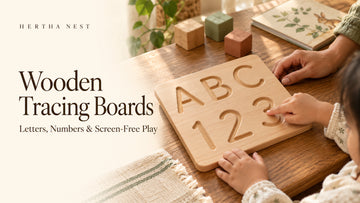
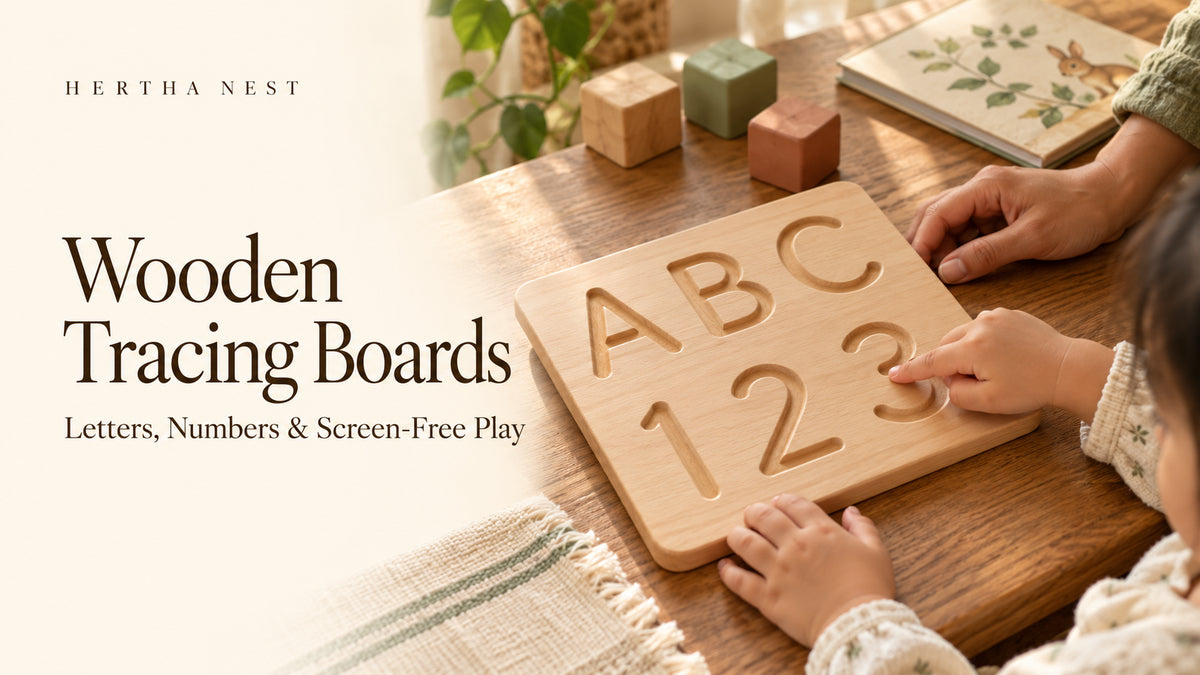
Wooden Tracing Boards: A Screen-Free Way for Kids to Learn Letters and Numbers
There is a familiar moment in many homes: your child asks for your phone while you are finishing dinner, answering a message or getting ready for the next day. You want another option, but finding something simple, interesting and easy to bring out can take thought.
A wooden tracing board offers one possibility. It gives children something physical to explore: a line to follow, a letter to notice or a number to talk about together.
You do not need to turn the activity into a lesson. Sitting beside your child, following a shape and asking a small question can be enough to begin.
Looking for wooden tracing boards in Mumbai? Hertha Nest offers educational tracing boards and stencils covering different letters, numbers and patterns. This guide explains how to choose a suitable board and make it part of relaxed, screen-free play at home.
What Is a Wooden Tracing Board?
A wooden tracing board is a learning resource with letter, number or pattern guides that children can follow. Depending on its construction, it may have grooves, cut-out stencil shapes or another guided format.
Before buying, check how the particular product works. A board designed for finger tracing may be different from a stencil intended for use over paper. Do not assume every board uses the same tools or method.
The activity introduces a physical way to explore written shapes. A child can look closely, follow a route and talk about what they see.
Tracing is one part of learning to write. Children also need opportunities to scribble, draw, hear stories, talk, play and eventually make marks without a guide.
Why Choose a Screen-Free Learning Activity?
Sometimes a family simply needs an activity that does not involve a screen.
A tracing board can offer a change of pace during an afternoon at home or a quiet moment between other activities. There is no video to choose or next episode to negotiate.
However, owning a board does not automatically change a child’s routine. It helps to make the alternative inviting.
Place it on a clear surface, sit nearby and begin with a playful suggestion: “Shall we follow this bend?” or “Can you find a shape that looks familiar?”
You do not need to describe screens as bad or make tracing feel like a punishment. Present the board as another enjoyable choice alongside books, drawing, building and outdoor play.
What Can Children Practise with Tracing Boards?
A tracing activity gives children opportunities to explore shapes through looking, movement and conversation. What they take from it will depend on their readiness, interest and the support around them.
Noticing Letters and Numbers
You can point out a familiar letter, compare two shapes or look for the first letter of a family member’s name.
Recognition and writing are different tasks. A child might recognise a letter before being ready to form it independently.
Following Lines and Changing Direction
Curves, straight lines and zigzags provide routes to explore. Children can experiment with moving slowly, stopping and changing direction.
Keep the focus on trying the movement rather than producing a perfect result.
Talking About What They See
Words such as “around,” “across,” “up” and “down” can become part of the activity.
The conversation matters as much as completing a shape. Leave time for questions, observations and the stories your child invents.
Choose a Board That Matches Your Child’s Starting Point
It is tempting to buy the most advanced-looking board because you hope it will last longer. A better starting point is an activity your child can approach with curiosity.
If letters feel frustrating, begin with lines or patterns. If your child already enjoys recognising letters, choose a board that connects with that interest.
Consider the script used at school and the languages spoken at home. Ask the teacher which letter forms or learning sequence would be useful to reinforce.
Check the manufacturer’s age guidance and instructions for the specific product. Readiness varies, and a product category alone does not establish suitability.
One well-chosen board is enough to start. You can introduce other designs when there is a reason to do so.
Explore English, Hindi and Marathi Options
Families in Mumbai may use more than one language during an ordinary day. A child might hear Marathi with grandparents, Hindi while playing and English at school.
Tracing activities can connect with those familiar experiences.
Hertha Nest’s collection lists English alphabet and number boards, Hindi and Marathi options, and line-pattern designs. These are separate product choices, so review each listing rather than assuming one purchase contains every language or activity. Browse educational tracing boards and stencils.
Let language practice remain conversational. Say a familiar word, look at its starting character and connect it with a person or object the child knows.
You do not need to introduce several scripts in one sitting. Follow your child’s interest and coordinate with what they are already learning.
Start with Patterns Before a Full Alphabet
A page or board filled with letters can feel like a large task. A single line offers a smaller invitation.
Try choosing one curve or zigzag and turning it into an imaginary journey. A finger might travel around a bend, climb a mountain or follow a winding road.
You could say, “This road turns here. Where do you think it goes?”
There is no need to complete every pattern. Repeating one favourite route can be part of the play.
Hertha Nest lists a Zigzag and Curve Lines tracing board, which parents can review when considering a pattern-based starting activity. Follow the selected product’s instructions for the appropriate tracing method.
Introduce Letters Through Familiar Names
A child’s own name can provide a personal place to begin.
Show the first letter and say, “This is the letter your name starts with.” Then look for it in a book, on a label or on a drawing you make together.
You can include names of siblings, grandparents or favourite story characters.
Avoid turning every moment into a recognition test. Instead of repeatedly asking, “What letter is this?”, sometimes model the answer and allow the child to join in.
When discussing letter sounds, use the approach recommended by the child’s teacher.
The board gives you a shape to explore. Familiar names give the activity a reason to matter.
Connect Number Tracing with Real Quantities
Tracing a numeral and understanding how many objects it represents are different experiences. Bring them together through simple play.
Choose one number on the board, then count a matching group of suitable objects together.
For example, trace three and count three large blocks. Touch each block once as you say its number.
Ask, “Can we find one more?” or “Which group has fewer?” only when those questions fit your child’s understanding.
Use age-appropriate materials and supervise the activity. Small loose objects are unsuitable for children who may put them in their mouths.
If your family is exploring Marathi numerals, review Hertha Nest’s Marathi Numbers tracing board and connect the symbols with counting activities at home.
A Simple Way to Introduce the Board
The first session can be brief and uncomplicated.
Choose a stable surface with enough room for the board and any recommended materials.
They may want to point, touch or ask a question before tracing.
Follow the product instructions and show a small part of the activity.
Invite participation without insisting that your child copy you immediately.
A short, enjoyable experience is a useful starting point. Stop when your child is ready.
You do not need a daily completion target. Notice whether your child wants another turn, prefers a different activity or is ready to stop.
Five Playful Activities to Try at Home
Find a Familiar Shape
Ask your child to choose a letter, number or pattern they recognise. If none feels familiar, choose one together. Talk about where you might see it elsewhere.
Follow the Imaginary Road
Turn a line into a journey for a finger, where suitable for the board. Describe the bends and pauses, then let your child decide where the road leads.
Trace and Draw
After exploring a shape, offer paper for free drawing. The drawing does not have to resemble the traced shape. It is another opportunity to make marks.
Count a Collection
Connect one numeral with a small group of suitable objects. Take turns arranging and counting them rather than asking your child to complete the task alone.
Teach a Favourite Toy
Invite your child to show a teddy or doll how the activity works. Pretend play can change the mood when a direct instruction feels like too much.
Keep Encouragement Specific and Pressure Low
It can be difficult to watch a child reverse a direction or move away from the guide. Before correcting, consider what the activity is meant to offer.
You might be introducing an unfamiliar shape, sharing a quiet moment or practising one movement. Perfection does not need to be the goal.
Try comments that describe the effort: “You followed that curve slowly,” or “You came back to try it again.”
If your child asks for help, demonstrate briefly and offer another turn. Avoid repeatedly moving their hand through the activity.
Stop if they become uncomfortable or frustrated. Returning another day is an ordinary part of learning, rather than a failed session.
Make Space for Drawing, Stories and Other Play
A wooden tracing board works best as one option within a varied day.
Keep paper and suitable drawing materials available so children can explore their own marks. Share books, sing songs, talk about everyday objects and make room for physical play.
These experiences give letters and numbers a wider context.
You might notice a number on a lift button, read a familiar name on a card or count plates while setting the table.
There is no need to turn each observation into an exercise. Sometimes simply pointing something out is enough.
The aim is to make written symbols part of an interesting world, with the board offering one way to explore them.
Choosing Wooden Tracing Boards in Mumbai
When searching for wooden tracing boards for kids in Mumbai, compare practical details before deciding.
Look at the board’s dimensions, tracing format, script and recommended use.
Check whether any tool is included and whether paper or other materials are needed separately.
Confirm whether an alphabet board contains capital letters, small letters or cursive forms.
For online orders, confirm availability and delivery estimates for your PIN code before payment.
Study the photographs and ask questions if the listing is unclear. Product titles and descriptions should agree; if they do not, ask the seller before ordering.
Choose according to your child’s current needs rather than buying several boards at once.
Visit or Contact Hertha Nest in Borivali East
Parents looking for educational tracing boards in Borivali East can browse Hertha Nest’s collection online and contact the business with product questions.
Hertha Nest
Shop No. 10, Ground Floor, DGS Sheetal Regalia, near Nancy Bus Depot, Borivali East, Mumbai, Maharashtra 400066.
Phone: 7506705286
Confirm opening hours and the availability of your selected board before travelling. If you prefer collection, ask whether it can be arranged. Contact Hertha Nest.
When making an enquiry, mention the exact language and design you want. This helps distinguish an alphabet board from a number or pattern board.
A Thoughtful Gift for a Young Learner
A tracing board can be a considered gift when it matches the child’s interests and the family’s preferred language.
Before buying, ask the parent what the child currently enjoys. Perhaps they are noticing letters in their name or beginning to count familiar objects.
Check whether the family already owns a similar resource.
You can make the gift more personal with an age-appropriate picture book or a note suggesting a shared activity. Keep the message inviting: “Something to explore together.”
Avoid presenting it as a way to make a child learn faster or get ahead of classmates.
A useful gift gives the family another enjoyable option without creating a new expectation.
Care, Storage and Everyday Checks
Follow the care guidance supplied for the selected board.
Hertha Nest’s tracing-board listings advise wiping with a soft cloth, avoiding water exposure and storing in a dry place. Check the individual instructions before cleaning or using any writing material on the surface.
Before each use, look for damage, rough areas or loose components. Keep unsuitable accessories out of reach and supervise according to the product guidance and your child’s needs.
Do not assume “wooden” means appropriate for every age.
Store the board where an adult can bring it out easily. Having a clear place for it makes setting up and putting away the activity simpler.
Begin with One Shape and a Little Time Together
You do not need an elaborate home-learning setup to introduce a screen-free activity.
Choose a suitable board, clear a small space and invite your child to explore one shape. Some days they may want several turns. On others, they may prefer a story or drawing.
Let the board support that curiosity without turning every attempt into a performance.
Explore Hertha Nest’s Educational Tracing Boards and Stencils to compare languages and designs. Start with what fits your child now, and make room for conversation, play and the pleasure of trying something together.
Frequently Asked Questions
What Are Wooden Tracing Boards Used For?
Wooden tracing boards provide guides for exploring letters, numbers or patterns. Depending on the design, children may follow grooves or use stencil openings. Check the individual product instructions because tracing methods and required materials can differ.
What Age Is Suitable for a Tracing Board?
Follow the manufacturer’s stated age recommendation and consider the child’s readiness. Look at the board’s size, accessories and intended use. Do not assume every product described as a tracing board is suitable for toddlers or all preschool children.
Can a Tracing Board Teach My Child to Write Independently?
Tracing offers guided practice, but independent writing involves more than following a shape. Include free drawing, mark-making, language activities and appropriate teaching. A board is a supporting resource, rather than a guarantee of handwriting progress.
Should We Begin with Letters or Patterns?
Begin with an activity your child can approach comfortably. Lines and curves may offer a manageable starting point, while a familiar letter may interest another child. Ask the teacher for guidance if you want to connect home activities with classroom learning.
Are Marathi and Hindi Tracing Boards Available?
Hertha Nest lists Hindi and Marathi tracing-board options alongside English designs. Review each product to confirm the script and content. Availability may change, and separate listings should not be treated as one combined set.
How Long Should a Tracing Activity Last?
Let your child’s interest and comfort guide the session. You can explore one shape and stop. There is no need to complete the entire board or continue once the activity becomes tiring or frustrating.
Can We Write Directly on Every Tracing Board?
No. Check which materials and methods the manufacturer recommends. A white surface does not automatically mean it is compatible with dry-erase pens. Ask the seller before using markers, pencils or cleaning products that could damage the finish.
Where Can I Buy Wooden Tracing Boards in Mumbai?
You can browse Hertha Nest’s educational tracing boards online and contact its Borivali East business location. Confirm the selected design, age guidance, availability and delivery information before ordering, or opening hours before visiting.