

Wooden Toys vs Plastic Toys: What Should Parents Choose for Their Kids?
Choosing toys for children can be surprisingly difficult. With so many options available, parents often find themselves comparing materials, designs, durability, safety and educational value before making a decision.
One common question is whether wooden toys or plastic toys are a better choice for children.
The answer is not simply that one material is always better than the other. Both wooden and plastic toys can have a place in a child's playroom.
What matters most is the individual toy: its design, age suitability, quality, safety and how the child is encouraged to use it.
Still, wooden toys have some qualities that make them an interesting option for parents who prefer simple, tactile and reusable play experiences.
What Makes Wooden Toys Different?
Wooden toys have been part of children's play for generations. Their simple construction often encourages children to interact with the toy through touching, arranging, building, sorting and imaginative play.
Unlike toys that depend heavily on lights, sounds or electronic features, many wooden toys leave more room for the child to decide what to do with them.
For example, a wooden puzzle can become a problem-solving activity, while blocks can be used to build houses, towers, roads or anything else a child imagines.
Wooden Toys vs Plastic Toys: A Simple Comparison
Both materials can be useful. The differences are easier to understand when you compare how they feel, how they are used and what kind of play they may encourage.
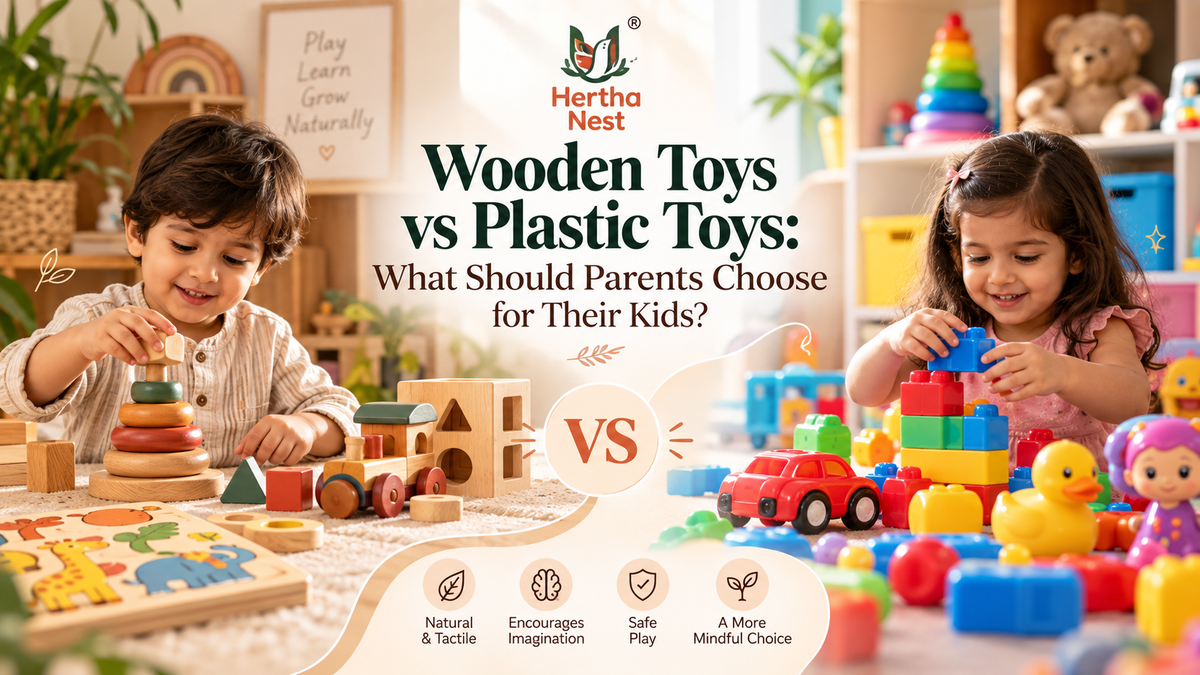
Wooden toys are primarily made from wood, while plastic toys are primarily made from plastic.
Wooden toys often have a natural and tactile feel, while plastic toys are generally lightweight and smooth.
Well-made wooden toys can be long-lasting. Plastic toy durability depends heavily on the quality of the individual product.
Wooden toys often encourage open-ended play, while plastic toys can range from very simple products to highly interactive electronic toys.
Wooden toys are often simple and classic, while plastic allows a very wide range of shapes, colours and features.
Wooden toy care depends on its finish, while many plastic toys are generally easy to clean.
Wood being a natural material can be an advantage, but sourcing, manufacturing, lifespan and disposal all still matter.
The right choice depends on the individual toy rather than the material alone.
Wooden Toys Encourage Hands-On Play
Children learn through interaction. Picking up, moving, stacking and fitting objects together can involve both physical and mental skills.
Wooden puzzles, blocks and activity toys can provide opportunities for children to experiment with shapes, sizes and arrangements.
The simplicity of many wooden toys can also encourage children to create their own games instead of following a fixed sequence.
Plastic Toys Offer Variety
Plastic toys should not automatically be considered a poor choice.
Plastic allows manufacturers to create lightweight products in countless shapes, colours and designs. Some plastic toys are also useful for specific activities and can be easier to clean.
The important consideration is whether the toy is appropriate for the child's age and intended use.
Parents can choose based on the individual product rather than assuming that every wooden toy is better than every plastic toy.
Wooden Toys Can Encourage Imagination
A simple wooden object can have many different uses during pretend play.
A child might turn blocks into a building, a wooden figure into a character or a small vehicle into part of an imaginary town.
This type of open-ended play gives children freedom to create their own stories and activities.
Plastic Toys Can Offer Interactive Experiences
Many plastic toys include sounds, lights, moving parts and other interactive features.
These features can make certain activities engaging, especially when they are designed around a specific learning objective.
Parents can also balance interactive toys with simpler toys that allow children to create their own play scenarios.
Consider Durability
A toy that can be used repeatedly over a long period may offer better value than something that is quickly discarded.
Good quality wooden toys can be sturdy and may remain useful as children grow, depending on their design and construction.
Plastic toys can also be highly durable, so parents should look at the actual quality of the product rather than judging durability by material alone.
Think About the Environmental Impact
The environmental side of toy selection is becoming increasingly relevant to many families.
Wood is a natural material, but that does not automatically make every wooden toy environmentally friendly.
Responsible sourcing, manufacturing, finishes and product lifespan all matter.
Plastic can also be durable and reusable, but disposal and the use of petroleum-based materials are important considerations.
A practical approach: Choose durable toys that are likely to be used for a long time rather than frequently replacing them.
Safety Should Come First
Material is only one part of toy safety.
Before buying a toy, parents should consider:
Check whether the toy is designed for the child's age group.
Pay particular attention to detachable components for younger children.
Inspect the toy for edges or surfaces that could cause injury.
Check whether parts are securely attached and suitable for regular play.
Consider the materials and finishes used on the individual toy.
Look at how securely and carefully the toy has been made.
Make sure the toy is being used in the way recommended by the manufacturer.
For younger children: Avoid toys containing small detachable parts that could present a choking risk, and always follow the manufacturer's age and safety recommendations.
Wooden Puzzles Can Make Play Educational
A well-designed puzzle can turn playtime into an opportunity to practise matching, observation and problem-solving.
Wooden activity puzzles are particularly useful when their design is appropriate for the child's developmental stage.
The Wooden Kids Activity Puzzle category at Hertha Nest is relevant for parents exploring wooden activity-based play options.
The goal should not be to turn every play session into a lesson. Children learn naturally when they are allowed to explore and experiment.
Choose Toys Based on the Child, Not Just the Material
Every child has different interests.
One child may enjoy building blocks, while another may prefer puzzles, pretend play or outdoor activities.
Instead of asking only "wooden or plastic?", consider asking:
What kind of play does my child enjoy?
That question can lead to a much more useful choice.
Look for Toys That Can Grow With the Child
Some toys have limited use because children quickly outgrow them.
Open-ended products can sometimes remain interesting for longer because the child can find new ways to use them.
Building pieces, puzzles and imaginative-play accessories are examples of products that can offer different levels of interaction as children develop.
Simple Toys Can Reduce Overstimulation
Children today have access to toys with many sounds, lights and moving features.
There is nothing inherently wrong with interactive toys, but a playroom does not need every toy to compete for attention.
Simple wooden toys can provide a quieter alternative where children can focus on one activity at a time.
A balanced toy collection can include both simple and interactive products.
Consider Storage and Organisation
The number of toys in a home can become difficult to manage.
Choosing versatile toys that serve multiple purposes can make organisation easier.
Wooden toys often have simple shapes that can be stored together in baskets, shelves or dedicated play areas.
The Wooden Kids Toys range can be considered when building a collection around traditional and activity-based play.
Quality Matters More Than Quantity
Children do not necessarily need a large number of toys.
A smaller collection of well-chosen toys can provide plenty of opportunities for play.
Rotating toys every few weeks can also make familiar items feel interesting again.
Instead of buying a new toy every time a child becomes bored, parents can sometimes introduce a different way to use an existing one.
How Should Parents Decide?
There is no universal answer to the wooden-versus-plastic debate.
A good decision can come from considering five things:
Is the toy appropriate for the child's age?
What skills or type of play does the toy support?
Is it made to handle regular use?
Will the child actually enjoy playing with it?
Are you comfortable with how the toy is made and maintained?
For parents who prefer natural materials and simpler designs, explore Hertha Nest wooden toys and activity-focused products alongside other handcrafted categories.
Final Thoughts
The wooden-versus-plastic toy question does not need to have a strict winner.
Wooden toys can offer simplicity, tactile interaction and opportunities for imaginative play.
Plastic toys can provide variety, lightweight designs and interactive features. Both can be useful when chosen carefully.
Rather than focusing only on the material, look at the quality, safety, purpose and play value of each toy.
The best toy is ultimately one that is safe, age-appropriate and gives a child a reason to explore, create and enjoy playing.
Frequently Asked Questions
Are wooden toys safer than plastic toys?
Not automatically. Safety depends on the individual product, its construction, materials, finishes and age suitability. Parents should always check the manufacturer's safety guidance.
Are wooden toys better for child development?
Wooden toys can encourage hands-on, imaginative and problem-solving activities, but the developmental value depends mainly on how the toy is designed and used.
Should parents stop buying plastic toys?
Not necessarily. Plastic toys can be useful and engaging. A balanced collection can include different materials and types of play.
What age is suitable for wooden toys?
It depends on the specific toy. Always check the recommended age range and avoid products with small detachable parts for children who may put objects in their mouths.
How many toys does a child really need?
There is no fixed number. A smaller collection of versatile toys can provide plenty of play opportunities, particularly when toys are rotated regularly.